
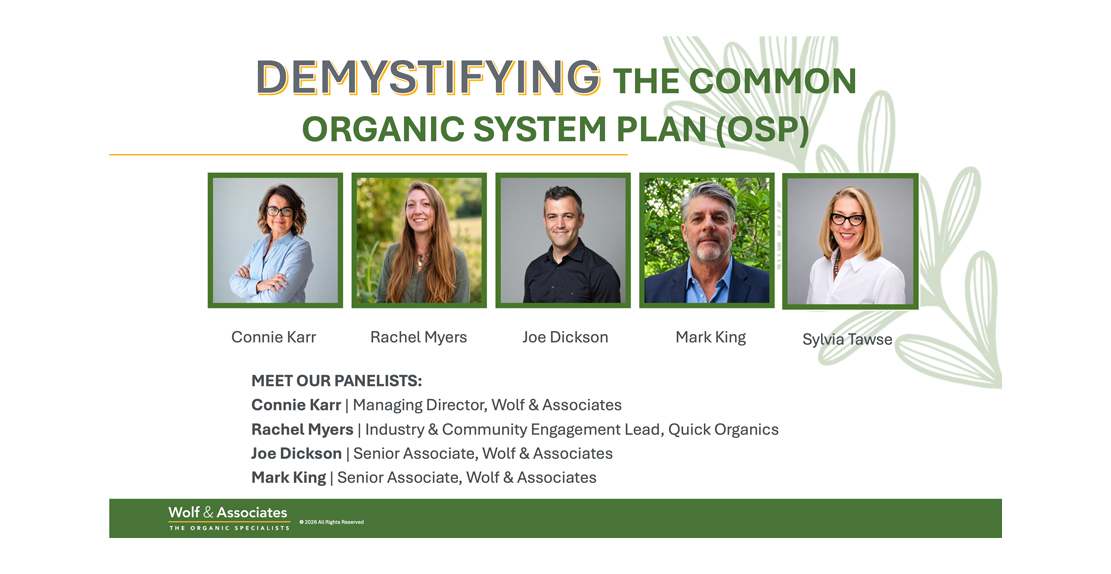
Continuing the Common OSP Conversation
The conversation doesn’t end when the webinar does. One of Wolf & Associates’ goals has always been to create opportunities for thoughtful, fact-based discussions around the issues shaping organic certification. This recap highlights the key themes, questions, and insights from our recent webinar while providing additional context for the conversations that will continue across the industry.
Watch the replay here, then continue to the Post-Webinar Follow-Up below :
Demystifying the Common OSP: Post-Webinar Follow-Up
A practical follow-up for certifiers, inspectors, certification staff, and organic decision makers
By John Foster, President, Wolf & Associates
If you have spent any time working on organic certification, you already know that the sector has a special talent for turning practical questions into loaded complications. A simple tool becomes a complex referendum. A framework becomes a threat. A proposed concept quickly earns a reputation before most people have had the chance to examine what it actually does. The Common Organic System Plan (OSP) was in that very phase when W&A hosted its webinar. Some “got it” and wanted the Common OSP as soon as possible. Some had heard enough to be intrigued, while others had heard enough to be suspicious. Quite a few appeared to have encountered the idea through secondhand sources that communicated a generalized concern that anything new must either save the sector or quietly dismantle it. In distilled terms, the Common OSP concept was in much need of clarity.
Wolf & Associates believed a calm, straightforward explanation was needed. The purpose of this follow-up is to capture and extend the central points from our webinar discussion and to make the proposed Common OSP more understandable after that conversation. This remains a practical orientation and not a manifesto. Our goal was to clarify exactly what the Common OSP is and provide context for why it emerged, where some of the confusion around it originated, and why certifiers, inspectors, certification reviewers, decision makers, and regulatory staff should become familiar with it. We all appreciate that organic certification already has plenty of genuine complexity. There is little value in adding invented mystery to the list.
The Common OSP and the Quick Organics Platform Are Related and Distinct
Here is the most important clarification: The Common OSP and the Quick Organics platform are related but they should not be treated as synonymous. Quick Organics operates a software platform. The Common OSP refers to a broader framework intended to support greater consistency in how organic system plan information is organized, presented, and understood. One may help deliver or operationalize the other, yet the two do not conflate into a single concept.
That distinction matters because much of the skepticism surrounding the Common OSP appears to stem from the assumption that it is merely a proprietary software platform feature, commercialized packaging, or a software-centered attempt to gain control over an essential part of the certification process. That is too narrow a view and, more importantly, it misses the real question. The real question is whether a more coherent framework for OSP information would benefit the organic sector. A software platform may affect how such a framework is used, maintained, or reviewed, but the existence of such a platform does not fully define the value of the framework itself any more than a website defines the regulation displayed on it.
Clear description is especially important here because this is a space in which people understandably bring concerns about governance, neutrality, accessibility, and motive. Those concerns deserve a fair hearing. They also deserve enough precision that the framework itself can be evaluated on its merits rather than only through assumptions about the channel through which it happens to be introduced. A shared structure for information should be analyzed as shared structure for information. The software question is real, though it is not the only question.
Why the Common OSP Emerged
The Common OSP did not arise because the organic sector was looking for a fresh acronym or a new issue to debate. It arose because a longstanding structural problem has remained unresolved for too long. Across the certification system, similar information is often requested, organized, and evaluated in strikingly different ways. Some variation is necessary. Organic operations differ from one another, certifiers differ from one another, and not every certification file should look as though it were stamped out of a single mold. No serious person is advocating for that kind of flattening.
The problem begins where variation no longer reflects meaningful difference and instead becomes an accumulation of avoidable inconsistency, redundant structure, and administrative friction. Operators spend time learning format rather than communicating substance. Inspectors spend time navigating layout rather than focusing on whether practice aligns with representation. Reviewers and certification staff spend time translating between organizational systems rather than evaluating the underlying organic issues. Training becomes more cumbersome. Internal continuity becomes harder to maintain. Capacity gets absorbed by sequence, labeling, duplication, and interpretation in ways that do not necessarily improve rigor or integrity.
The structure of reported information has practical consequences. It affects the accessibility of certification, the efficiency of inspection and review, the ease of training new staff, the consistency of decision making, and the amount of time a system spends on administration rather than substance. Over time, those burdens become normalized simply because people have grown accustomed to them. Familiarity, however, is not the same as necessity. The fact that a process has long been cumbersome does not make cumbersomeness an unavoidable reality.
The Common OSP is an attempt to respond to that clunky condition by creating a more coherent shared framework for the presentation and organization of OSP information. That goal should not be mistaken for a demand that every certifier become identical or that every operation answer every question in the same way. Organic certification will continue to require judgment, context, discretion, and adaptation to actual conditions. A more coherent framework does not eliminate those needs. It can, however, improve the conditions under which that professional judgment is exercised.
What the Common OSP May Offer the Certification Community
For certifiers and certification staff, the significance of the Common OSP is practical rather than philosophical. A more coherent framework will support stronger internal consistency, reduce avoidable administrative noise, improve training efficiency, and make review processes easier to navigate. When core information is organized more predictably, staff can spend less time locating or translating information and more time assessing what it means. That is a meaningful gain in any system, especially one that depends heavily on skilled people whose time is already overcommitted.
A further, practical accreditation point is worth naming. A certifier that accepts the Common OSP as an adequate structure for collecting and organizing OSP information may be substantially freer from the particular concern that NOP Accreditation will issue a noncompliance because the certifier’s own proprietary OSP form is incomplete, outdated, or errant in its design. This is not a blanket safe harbor. It does not prevent NOP Accreditation from identifying problems in how a certifier reviews, verifies, or applies the information it receives. But it does reduce the burden and risk of every certifier having to defend a separate homegrown OSP structure, and it allows accreditation attention to focus more appropriately on implementation, decision making, and the quality of the certification file.
For reviewers and certification decision makers, the advantages may be even more immediate. A more common structure can make comparison across files easier, support smoother handoff between personnel, and reduce the amount of professional time spent deciphering different organizational logics that are trying, in substance, to communicate much the same thing. Better informational architecture does not remove the need for rigor. It simply means the rigor can be directed where it most belongs.
Inspectors may also find the practical benefits substantial. Better organized OSP information can improve preparation, support a more efficient inspection process, and allow more attention to focus on the relationship between records, claims, practices, and on-site reality. Inspectors already carry a large interpretive burden. Asking them to function simultaneously as archaeologists of document design has never seemed the most strategic use of limited sector capacity.
Operators, even though they were not the primary audience for the webinar, should not be left out of the picture. A more coherent framework can make certification easier to understand, easier to navigate, and less dependent on insider fluency with shifting structures and expectations. That matters if the sector is serious about accessibility. Organic has spent many years wrestling with the perception that participation can feel easier for the well-resourced, the highly experienced, or the professionally guided. Some level of complexity is inevitable. Unnecessary friction should not be mistaken for seriousness.
Why Motive Has Become Part of the Discussion
Some of the reaction to the Common OSP has centered less on the framework itself and more on assumptions about why it was developed. That deserves to be addressed directly. Wolf & Associates participated in this effort because we believed the work was worth doing for the good of the overall organic sector. Neither Wolf & Associates nor Quick Organics received grant funding to develop this work. Wolf & Associates has no ownership interest in Quick Organics. We contributed time, expertise, and labor because the underlying need was real and because the potential value was broad.
At the same time, Quick Organics operates a software platform and may continue to develop tools that help users engage with certification more efficiently. Those facts coexist. They do not cancel one another out. The sector should be capable of recognizing that a commercial actor may also contribute to work that addresses a broader system need, just as it should be capable of scrutinizing such work carefully and asking hard questions about governance, use, flexibility, and long-term implications. Those are healthy questions. They become less useful when the existence of a platform is treated as proof that the framework itself lacks public value.
There is also a cultural habit in organic of treating any proximity between initiative and commerce as morally suspicious by default. Sometimes that instinct serves the sector well. Sometimes it merely shortens the route to caricature. The better course is to examine the substance, identify the real risks, separate those from imagined ones, and assess whether the framework improves the conditions under which certification actually occurs. Sincerity of intention is not proved by having no business model. Usefulness is not disproved by the presence of one.
What a Thoughtful Sector Conversation Should Look Like
The Common OSP should be discussed seriously, examined carefully, and criticized where criticism is warranted. None of that threatens the project. In fact, that is exactly how a sector should approach an effort aimed at shared infrastructure. Useful questions are readily available. Does the framework improve clarity? Does it reduce unnecessary duplication? Does it preserve enough flexibility for different operation types and certifier approaches? Does it support inspection and review rather than distort them? Does it lower friction without lowering rigor? Does it make certification more understandable and more workable for the people who have to use it every day?
Those are the kinds of questions that can help a promising framework become a better one. They are also the kinds of questions that can expose weaknesses if weaknesses are present. What tends to be less productive is beginning and ending with ambient distrust, as though suspicion itself were a substitute for analysis. Organic has earned its cautious streak, though caution works best when attached to specific facts.
The Questions the Sector Is Really Asking
One of the useful outcomes of the webinar was that it moved the Common OSP discussion away from generalized suspicion and toward the practical questions that actually matter. The questions raised by participants were not abstract objections to improvement, nor were they simple requests for a better form. They reflected a sector trying to understand whether the Common OSP can become useful shared infrastructure without becoming rigid, proprietary, overpromised, or disconnected from the realities of inspection and certification.
The first question underneath many of the others is governance. If the Common OSP is to become a broadly used framework, the sector will reasonably want to know how it will be maintained, who will be involved in future revisions, how certifier experience will be incorporated, and whether updates will be managed transparently. Shared structure requires shared confidence. A framework that is intended to support consistency across certification cannot depend only on its initial usefulness. It also needs a credible path for stewardship, improvement, and adaptation as standards, operation types, and certification practices evolve.
A second set of questions concerns burden. Many organic operations and certification staff already experience OSPs as long, repetitive, and difficult to navigate. In that context, the promise of a Common OSP is not simply that it might make paperwork look more uniform. The more important question is whether it can reduce unnecessary work without reducing rigor. The sector is asking whether a common structure can reduce duplicative formatting, repeated explanations, certifier-specific learning curves, and avoidable back-and-forth, while still allowing certifiers to ask what they need to ask and operators to explain what they actually do. The distinction between necessary complexity and format-driven complexity is essential. Organic operations have become more complicated. Supply chains, subcontracting, private label arrangements, livestock standards, import requirements, and enforcement expectations have all added real complexity. The Common OSP cannot make those realities disappear. It can, however, help keep real complexity from being buried under unnecessary structural variation.
A third question is how the Common OSP relates to inspection and fraud prevention. This is an important point because no form, however well designed, prevents fraud by itself. Organic integrity still depends on competent inspection, careful review, material verification, records reconciliation, residue testing where appropriate, and the professional judgment of trained people. The Common OSP should not be presented as a substitute for any of those functions. Its stronger and more defensible value is that better organized information can improve the conditions under which those functions occur. If inspectors can more readily understand the operation before arriving on site, if reviewers can more consistently locate key information, and if certifiers can more easily identify gaps, contradictions, or risk points, then the OSP becomes a better tool for oversight. That is different from saying the OSP itself provides assurance. It does not. It provides a structured representation of the operation that must still be tested against records, practices, and reality.
A fourth question concerns accreditation risk and regulatory confidence. Certifiers are reasonably attentive to whether their OSP forms are sufficient, current, and aligned with NOP expectations. One practical value of the Common OSP is that it gives certifiers a stronger basis for confidence that the core structure they are using reflects a carefully considered, sector-facing framework rather than a locally inherited or internally improvised document. That does not mean adoption creates a safe harbor from NOP Accreditation findings. Certifiers remain responsible for how the OSP is implemented, reviewed, maintained, and applied to actual operations. But a well-developed Common OSP can reduce the concern that a certifier’s own form is materially incomplete, poorly organized, or out of step with the information architecture expected for certification oversight. In that sense, the Common OSP may help shift accreditation attention away from whether the basic OSP template itself is adequate and toward the more important question of whether the certifier is using it effectively.
A fifth question is compatibility. Organic certification is not confined to a single domestic pathway. Many certifiers and operations work across NOP, COR, EU, LPO, and other equivalency or export-related programs. Operations outside the United States may already use combined templates designed to capture multiple standards at once. For those users, the Common OSP will need to be understood not only as a U.S. organic form, but as a potential organizing framework that may need to coexist with other program requirements. The sector will want to know whether the Common OSP can support that kind of flexibility or whether it will need companion modules, overlays, or adaptations for multi-standard certification environments.
A sixth question concerns what comes next. Once a common structure exists for the OSP, it is natural to ask whether other parts of the certification system could benefit from similar treatment. Participants raised questions about a common inspection report, grower group applications, residue testing integration, connections to conservation planning, and the relationship between OSP information and digital tools. These questions show that the Common OSP is already being viewed as more than a single document. It is being viewed as a possible first step toward a more coherent certification architecture. That possibility is promising, but it also requires discipline. The sector should not rush to standardize everything simply because one common framework may be useful. Each next step should be evaluated on its own terms: whether it improves clarity, reduces unnecessary friction, preserves professional judgment, and supports organic integrity in practice.
Finally, there is the emerging question of artificial intelligence. A more common OSP structure may make it easier for operators, consultants, certifiers, or software tools to use AI to help organize information, identify missing sections, draft preliminary responses, or prepare applications. That possibility should be treated seriously but carefully. AI may help reduce some administrative burden, especially where users struggle with form completion or repetitive narrative drafting. But it also creates risks if polished language substitutes for accurate operational description. The operator must remain responsible for the truthfulness of the OSP. Certifiers must remain attentive to whether an answer reflects actual practice rather than generic compliance language. A common structure may make AI assistance more feasible. It should also make verification more important, not less.
Taken together, these questions suggest that the Common OSP conversation has entered a more useful phase. The sector is no longer only asking, “What is this?” It is asking, “How will this be governed? How will it reduce burden? How will it affect inspection? How will it interact with fraud prevention, accreditation, international certification, conservation planning, residue testing, software, and AI? What will it make easier, and what responsibilities will remain exactly where they belong?”
Those are the right questions. They should not be treated as resistance to the Common OSP. They are the questions that determine whether the Common OSP can become a durable and trusted tool. If the framework proves useful, it will not be because it eliminates judgment, complexity, or responsibility. It will be because it helps organize the information needed for judgment, complexity, and responsibility to be handled more clearly.
This conversation remains especially timely because certification capacity and usability are not theoretical concerns. They are active pressures in the system right now. Anything that might reduce unnecessary strain while preserving rigor deserves close attention. At the same time, first impressions around the Common OSP were already beginning to solidify before the webinar and remain important now. That creates both opportunity and risk. The opportunity lies in engaging the concept on its actual terms before narratives harden. The risk lies in allowing shorthand, rumor, or platform anxiety to do the explanatory work for us. Once that happens, clarification becomes a longer, duller task, and organic paperwork has already consumed enough human vitality for one generation.
The goal of W&A’s hosted webinar was a modest but important one: to make the Common OSP more familiar, place it in proper context, and create a better basis for informed discussion. We did not ask participants to suspend judgment. We asked them to direct judgment toward the right object. A sector-facing framework for improving the coherence of OSP information deserves to be understood as such, even where questions remain about implementation, governance, or adoption.
At Wolf & Associates, we have long believed that the organic sector benefits when its core tools become more coherent, more usable, and more accessible to the people expected to rely on them. That belief is what led us to contribute to this effort, and it is what leads us to encourage continued, open-minded engagement with it now. If the Common OSP proves useful, it will do so because certifiers, inspectors, reviewers, and decision makers find that it helps the system work more clearly in practice. That is a standard worth applying.
We thank the certifiers, inspectors, reviewers, certification decision makers, regulatory staff, and policy observers who joined us for “Demystifying the Common OSP,” a focused briefing in which we walked through the framework in more detail, clarified where misunderstandings have arisen, discussed how it relates to but remains distinct from the Quick Organics platform, and considered why a more coherent approach to OSP information matters to the future usability and accessibility of organic certification. If the sector wants integrity that can scale without becoming less intelligible, this remains a conversation worth continuing. We appreciate the thoughtful engagement and look forward to continuing the discussion.