
NEWSLETTER - August 7, 2026
Global Lens
Exporting to UK? New Agreement Brings Change
A new sanitary and phytosanitary agreement between the United Kingdom (UK) and the European Union (EU) on the trade and movement of plants, plant products, animals, animal products, feed and food is expected to be in force by mid-2027. US exports to the UK will be required to meet EU‑equivalent organic production, processing, and labelling requirements and use the EU’s TRACES NT system. Rules for poultry and livestock, pet food, use of flavors, seeds, plant reproductive material, use of EU organic logo and statement of origin will likely differ from current UK standards.
Organic Farming Grows in China as Organic Food Gains Popularity
The Economist reports that China’s organic farmland acreage doubled between 2014 and 2024, when it comprised 0.7% of the country’s total farmland. In that decade, organic sales more than tripled to $16.7 billion in 2024, and rose 19% from 2023 to 2024.
Inside the Beltway
What’s Ahead for Organic Regulations
In the latest version of the Unified Agenda from the Office of Information and Regulatory Affairs, USDA’s regulatory priorities include a proposed rule for inert ingredients (perhaps even this month!), rulemaking on compost used in organic production (with a proposed rule August 2027), and National List amendments for carbon dioxide, meloxicam, methionine, and sodium nitrate. We’ll keep you informed as comment periods open.
HTS Code Filing Requirements Change
As of July 1, USDA’s Agricultural Marketing Service changed some Harmonized Tariff Schedule (HTS) codes from “may file” (AM7) to “must file” (AM8), with reject severity. Products include: organic vegetables, oil seed, oleaginous fruits, plants, saps and extracts, vegetable fats and oils, avocado oil, sugars, cocoa and chocolate, pasta, baking products, biscuits, juices, soups and broth, vodka, tequila, and more.
NOP’s Common Organic System Plan Templates Available
The National Organic Program has posted a Common Organic System Plan (OSP) that organic farms, businesses and certifiers could adopt to comply with USDA organic regulations. Designed to both streamline and strengthen organic certification across the sector, the Common OSP includes information on production practices, processing and how organic products are protected as they travel along supply chains.
Wolf & Associates was honored to participate in this project; for more information, see our webinar recording on Demystifying the Common Organic System Plan.
Organic Certification Cost Share Funds Available
Apply Now for Organic Certification Cost Share Funds
USDA Farm Service Agency (FSA) is accepting applications from both producers and handlers to help with organic certification costs for the 2025 and 2026 program years through the Organic Certification Cost Share Program (OCCSP):
- Producers and handlers are eligible to receive 75% (up to $750) for each of the following organic certification scopes: crops, wild crops, livestock, processing/handling and state organic program fees.
- FSA will make payments as applications are received on a first-come, first-served basis until available funds are depleted; applications are due by Dec. 31, 2026, for both program years.
Specialty Crop Multi-State Program Grant Deadlines
The 2026 Specialty Crop Multi-State Program (SCMP) grant application is open, with approximately $14.3 million available. AMS will competitively award funds to enhance the competitiveness of specialty crops through collaborative, multi-state projects that address: food safety; plant pests and disease; research; crop-specific projects addressing common issues; and marketing and promotion. Application deadlines vary, depending on state participation, but start August 31 for multi-state applicants in California, Montana, Nevada, New Jersey, South Carolina, and Texas.
EPA Wants to Help Develop Chemical Desiccant Alternatives
The Environmental Protection Agency (EPA) is seeking public input in developing a $30 million Innovation Challenge focused on practical, cost-effective alternatives to using conventional pesticide chemicals for crop desiccation. One outcome of the challenge would be a reduction of conventional pesticide chemical desiccant use. Growers and other stakeholders are invited to comment.
Meet Casserole
As we doggedly track changes shaping the organic industry, meet Casserole, President John Foster’s watchful sidekick. Like John, she keeps an eye on her environment and knows when something requires attention.
That same foresight drives our Watchdog Program.Our Organic Specialists help you:
🐾 Anticipate regulatory and market shifts
🐾 Understand the implications for your business
🐾 Make informed decisions with confidence
You gain a strategic advisor who helps you act before challenges become problems. Learn More!

On Our Radar
True Cost Economic Analysis Favors Organic Agriculture
Deloitte’s analysis The Hidden Bill compares the economic benefits and societal costs of the current agricultural system in the Netherlands with a cumulative series of four alternative systems, with organic agriculture as the foundation. Once a monetary value is assigned to both the economic benefits and societal costs of agriculture (climate change, pesticides, water, biodiversity loss, etc.), organic systems provide greater economic benefit.
Awareness of Regenerative Agriculture Expands
In its annual survey of 2000 US adults, Kiss the Ground found that 13% report a working understanding of regenerative agriculture, up from 4% in 2023. Personal health benefits (72%) and food freshness (76%) outranked broader indicators like environmental concerns (32%) as shoppers’ drivers of purchase.
IOAS Adds Regenerative Agriculture Accreditation
IOAS has granted is first accreditation to a certification body with a scope of regenerative agriculture. The US-based certifier ‘A Greener World’ extended their current ISO/IEC 17065 accreditation to include their own standard ‘Certified Regenerative by AGW.’
Proven Nature-Based Pest Control Solutions to Explore
An international team of scientists reviewed the principals of nature-based pest control typically used in indigenous communities, and found some promising alternatives to conventional chemical-based pest control. “Nature-based solutions and indigenous knowledge for sustainable biological control” highlights the importance of natural enemies and pollinators in enhancing pest control and pollination.
People & Events
Rodale Institute Campaign Kicks Off
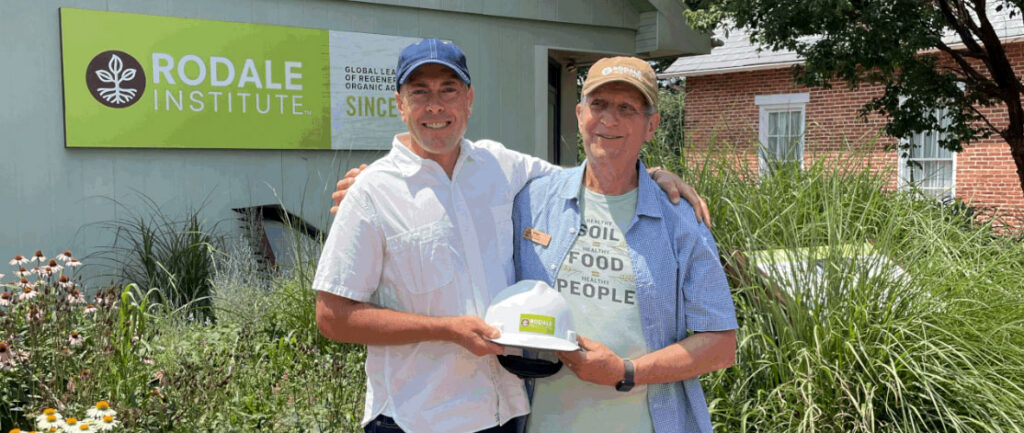
Our Founder Bill Wolf, a member of the Rodale Institute Board of Directors, was on hand for the announcement of Rodale’s newest initiative—the 10 Million Acre Solution. Part of its $139 million comprehensive campaign, the strategic plan will use research, education, consulting and strategic partnerships to catalyze the transition of 10 million acres of US farmland to organic and regenerative organic by 2030. Rodale’s new Center for Regenerative Organic Innovation—a keypart of the campaign—broke ground during their Annual Field Day event at the Kutztown, Pennsylvania headquarters.
Photo: Bill Wolf and Roldal Institute CEO Jeff Tkach
Free Marketing Tools for Farmers
In order to provide marketing technical assistance to organic farmers as part of the Transition to Organic Partnership Program, the Organic Farmers Association developed a storytelling resource hub. The tools in the hub help farmers highlight their businesses and build trust with buyers and consumers.
Thank You, Dr. Kathleen Delate
Groundbreaking organic agriculture researcher Dr. Kathleen Delate is now a Professor Emeritus at Iowa State University. During her career in a state dominated by conventional agriculture, she investigated appropriate crop rotations, organic no-till, varietal response, and integrated crop-livestock systems to improve soil quality and economic returns. She also built the organic community through her leadership on the annual Iowa Organic Conference.
Where to Find Us
Bill Wolf, John Foster, Joe Dickson, and other members of the Wolf & Associates team will attend the Organic Trade Association’s Organic Week 2026, September 14–16 in Washington, D.C.
We’ll be exhibiting in the Tabletop Showcase and participating in the timely discussions shaping the future of organic. If you’re attending, we’d welcome the opportunity to learn more about your priorities, discuss the challenges facing your organization, and share how our team can help.