

NEWSLETTER - June 30, 2026
By John Foster, President, Wolf & Associates
Organic certification depends on records, but of course organic integrity depends on more than that.
This is an important distinction. In any credible certification system, documentation matters. Records show what was purchased, planted, applied, harvested, handled, shipped, cleaned, fed, treated, made or sold. They allow certifiers to verify compliance and help operators demonstrate accountability.
When documentation becomes disconnected from actual practices, certification risks becoming too focused on whether the paperwork looks right and not focused enough on whether the organic system is working.
I’ve been thinking about this a lot lately, reflecting on the conversations at the National Organic Standards Board meeting in Omaha last month about how an Organic System Plan (OSP) template can either serve or discourage any of the stakeholders, especially producers and handlers.
That is why an OSP template remains so important. It should not be treated as a static form or annual administrative exercise. It should describe how the operation actually functions: the practices, choices, risks, safeguards, and improvements that give organic production its meaning.
As organic continues to mature, we need to improve and preserve this balance. Strong records are essential, but they are not the goal. The goal is organic integrity. Records should help reveal that integrity, not stand in for it.
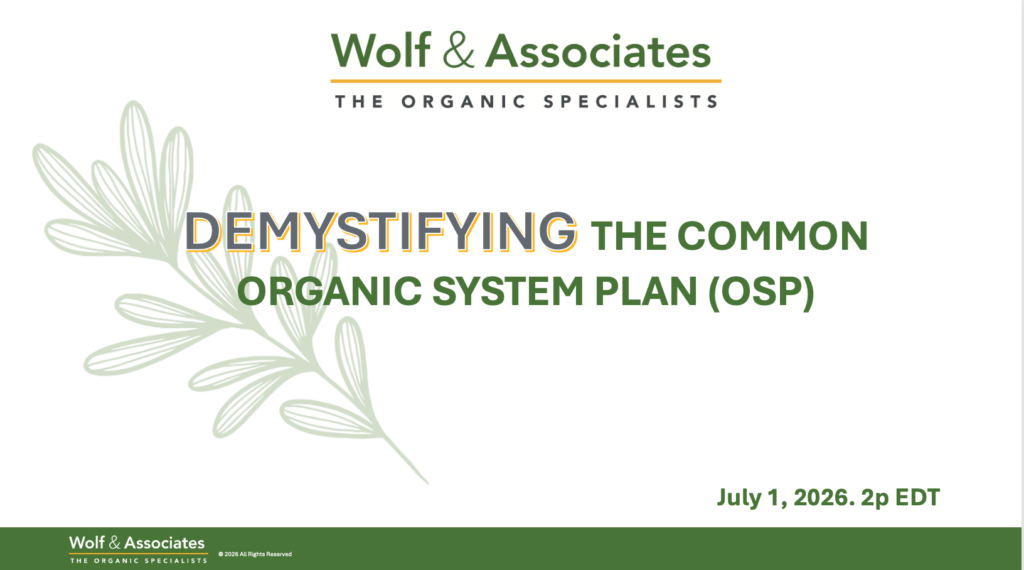
The Organic System Plan (OSP) is the foundation of organic certification, yet many operators find it confusing, time-consuming, and difficult to navigate.
What if there were a better way?
On Wednesday July 1 at 2 p.m. EDT, join Wolf & Associates and a distinguished panel of organic industry leaders for an engaging discussion on the origins, purpose, and potential of the Common OSP. Together, we’ll explore how a more standardized approach can reduce complexity, improve consistency, and expand access to organic certification for producers, processors, handlers, and certifiers alike.
Whether you’re currently certified, considering certification, or simply interested in the future of organic integrity, this webinar will provide valuable insights into one of the industry’s most important modernization efforts.

Your Questions Answered Live
We’ll close with a live Q&A, putting your most pressing question to our panelists:
Connie Karr | Managing Director, Wolf & Associates
Rachel Myers | Industry & Community Engagement Lead, Quick Organics
Joe Dickson | Senior Associate, Wolf & Associates
Mark King | Senior Associate, Wolf & Associates
Global Lens
Sales Up, Acreage Down in Canada
Organic products sales in Canada are up 24% from 2023 to reach about $11.8 billion in 2025, according to the most recent market research from Canada Organic Trade Association. Vegetables have the highest market share of any organic category at 5.3%. About 2.61 million acres are certified organic in Canada, down 6.2 % since 2023.
Long-term Soil Research Destroyed in Canadian Program Closure
Despite assurances from Agriculture and Agri-food Canada that researchers in the discontinued Organic and Regenerative Research Program at the Swift Current Research and Development Centre would have a year to complete their projects, the research plots were cultivated and planted with organic wheat. The move destroyed plot boundaries, making it impossible to collect soil data from long-term studies.
UK Organic Land Increases
Organic land increased 7.3 percent in the United Kingdom, up to 540,000 hectares, driven by increases in Scotland to meet government targets. Scotland’s organic land share is 3.3%.
Fiji Steps Up Organic Farming
The government of Fiji’s National Organic Policy 2026-2030 seeks to increase organic production, strengthen food security by using local inputs, improve climate resilience with sustainable soil management, and improve certification systems and oversight via coordinated implementation to enhance market access. First year funding for organic research and development is $300,000.
New Zealand Appoints a Minister for Organic Ag
Mike Butterick MP is New Zealand’s new Associate Minister of Agriculture, with delegated responsibility for the organic sector. Certified organic land in New Zealand is about 0.6% of productive land yet results in about 1.2% of the value of the country’s food and fiber exports.
Inside the Beltway
Senate’s Version of the Farm Bill Made Public
The US Senate unveiled its version of the Farm Bill on June 23. Among the provisions of interest to the organic sector would use risk-based oversight for organic inspections, require the USDA to test high-risk bulk imports of organic feedstuffs for prohibited residues, slowly increase the National Organic Program budgets, and authorize additional discretionary cost-share support. This version of the bill provides a smaller increase in Environmental Quality Incentives Program (EQIP) than the House version. The senate is expected to mark up the bill after the July 4 recess.
SOE: One Year Later
Data compiled from the first full year following implementation of the Strengthening Organic Enforcement (SOE) regulations reveals that beef is the top commodity exported to the United States by dollar value and represents 8.5% of the total value of organic imports. Full detailed data for organic imports in 2025, broken down by Harmonized Tariff Schedule (HTS) code, is on NOP’s website. The NOP Import Certificate (NOP-IC) requirement is also leading to data for focused investigations and effective enforcement actions.
NOP Offices to Remain in DC
USDA reorganization will keep Agricultural Marketing Service mission areas (which include the National Organic Program) in continuous operation without a reduction in force. Although future hiring will take place at hubs across the country to gradually reduce the capital-region footprint, we understand that current DC-area NOP staff will remain in the DC area.
Regulatory Updates
Produce Misting Investigation Results in Settlement
After an investigation into the organic produce misting practices at grocery stores across Texas, Albertsons Safeway LLC stores will stop using ProduceMaxx or any other synthetic antimicrobial pesticide in misting systems on organic produce, thanks to a settlement agreement with the state. Use of ProduceMaxx, an EPA-registered antimicrobial pesticide containing hypochlorous acid, must be followed with a potable water rinse in order to comply with organic regulations.
GMO Updates
EU Passes Regulations for Gene Edited Plants
New European Union regulations for plants obtained through new genomic techniques (NGTs), such as gene editing, will create two regulatory pathways, depending on the number of genetic modifications to the plant. Category 1 plants are considered equivalent to conventionally bred varieties and have no more than 20 modifications. Although they are exempt from risk assessment, Category 1 plants must be labeled and are excluded from organic production. Category 2 plants remain subject to EU’s existing GMO authorization, risk assessment, traceability, and labeling requirements. Expect a 2-year implementation period once the regulations are published in the Official Journal.
Group Stops ‘Natural’ Label on GE Food Color
An objection from the public interest group GMO/Toxin Free USA led to an indefinite delay for adding Beetroot Red—produced by Photolon through the genetic engineering process of precision fermentation—for use in human foods. The group argued that the color should not be labeled as “natural,” and users should not be allowed to label products as “no artificial colors.” In addition, they said the maker failed to provide adequate proof of safety for long-term human consumption.
On Our Radar
What is More Profitable—Organic or Conventional?
A new analysis from Purdue University compares crop yields, gross revenue, total expense, and net returns for conventional and organic alfalfa, corn, oats, soybeans, and winter wheat. Organic corn and soybean enterprises had lower crop yields, higher crop prices and gross revenue, higher total expenses, and higher net returns. On average alfalfa, oats, and winter wheat grown conventionally had similar net returns to those grown organically.
Less Cancer Risk From Eating Organic? Scientists Take a Look
A study examining whether or not eating organic fruits and vegetables made a difference in cancer rates found that substituting organic fruits and vegetables for conventional was associated with a 2% reduction of overall cancer risk, and a reduced risk of postmenopausal breast cancer. The analysis, published in the American Journal of Clinical Nutrition, used data from over 30,000 adults participating in the French NutriNet-Santé cohort.
Marketing Meets Mission
How do Organic and Regenerative Labels Differ?
Friends of the Earth evaluated 10 prominent food labeling programs, and found that certifications using the term “regenerative” vary dramatically in what they actually require—and some of the most rigorous standards meeting regenerative principles don’t use the term at all. In their analysis, USDA Organic, Regenerative Organic Certified and Real Organic Project are the most reliable and enforceable standards when it comes to chemical use and soil health.
People & Events
Opportunities Abound at Organic Seed Alliance
- Submit proposals for the March 2027 in-person and virtual conference sessions by July 15.
- Join the team—Submit Research and Education Director position applications by July 3.
Stephens’ Donation Establishes Medical School
A $40 million donation from Ratana and Aaron Stephens, founders of Nature’s Path, has established Simon Fraser University’s Stephens Family School of Medicine. Grounded in community, equity, innovation, and Indigenous approaches to care, the program focuses on primary care and community-based learning across urban, rural, remote, and Indigenous settings. Congratulations to all involved!