
“People grow through experience if they meet life honestly and courageously. This is how character is built.” ~Eleanor Roosevelt
Lessons from Biofach
By John Foster, President, Wolf & Associates
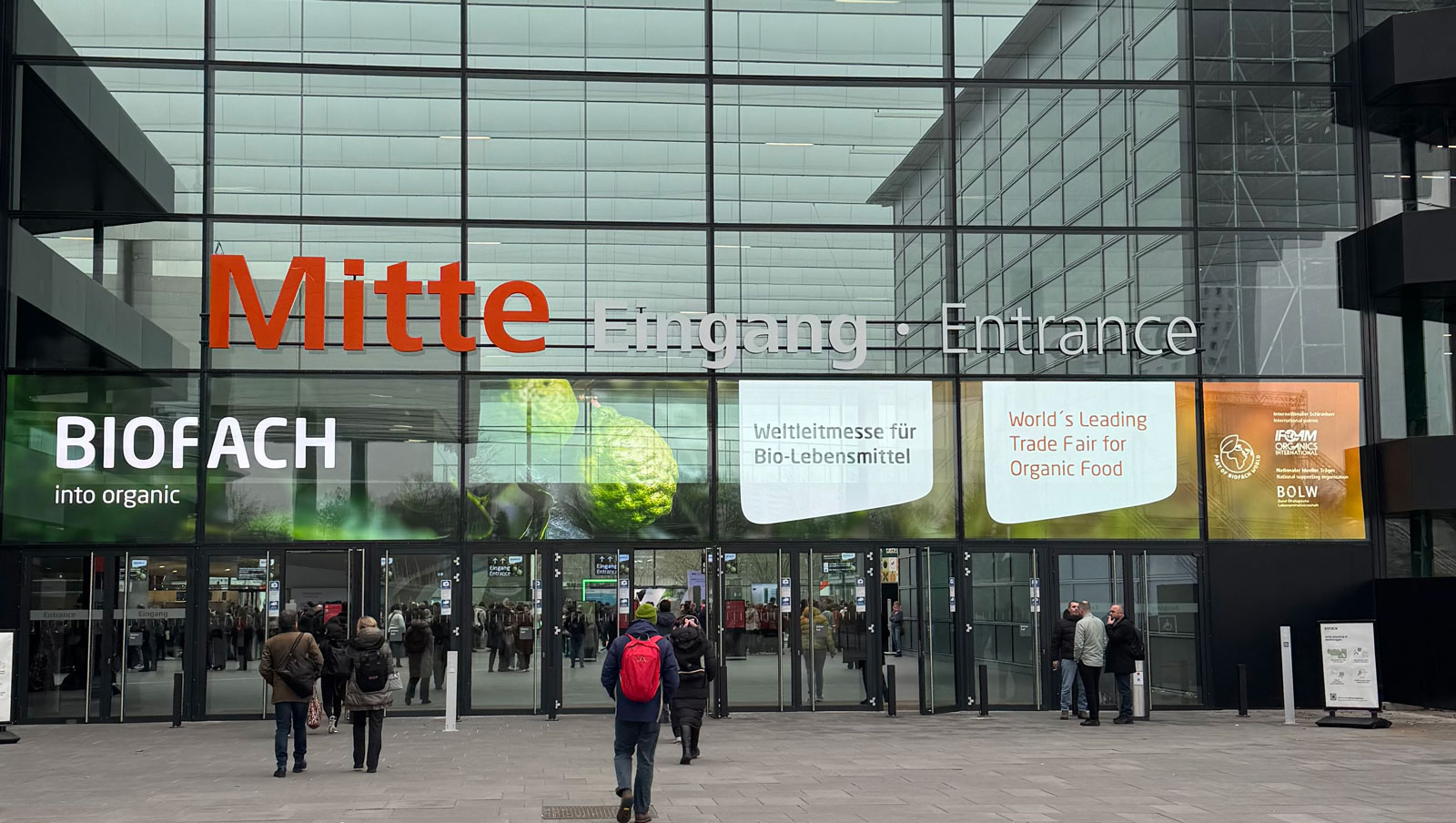
I recently attended Biofach Trade Fair and Congress in Nuremberg, Germany—not my first time at the event but my first in my role as President of Wolf & Associates. What struck me most was how the organic system actually functions when viewed in its entirety – globally.
Biofach is often called the world’s largest organic trade fair, but its real value lies beyond scale. It is one of the few places where all features of the global organic system are fully visible at once: retail goods, ingredients, services, multilingualism, regulation, deeply interconnected participants – sustained by trust between people who, in many cases, have never met and may never meet again. Spending time there has a way of recalibrating one’s perspective.
One thing that became clear immediately is how the U.S. market looks from the outside. The United States represents more than 40 percent of global organic demand, yet it is easy—especially when working domestically—to lose sight of how dependent that demand is on imports. Walking the halls at Biofach, that dependence is not abstract. It is visible in conversations, in relationships, and in the quiet confidence of suppliers who understand how much of the U.S. organic marketplace relies on their work. Whether we recognize it or not, organic consumption in the U.S. is supported by a global network of producers, processors, exporters, certifiers, and logistics partners operating within shared standards. That reality deserves more attention than it often receives, and I plan on calling that out more in the future.
Another observation surprised me in its simplicity. English functions as the primary language of trade across the organic sector. Over several short walks of the exhibition floor, I heard well over a dozen languages spoken—sometimes within the same conversation—but English was consistently the bridge. In a sector defined by regulatory nuance, that shared language can reduce friction and misunderstanding in meaningful ways. For U.S. operators, this often is a quiet but significant advantage—one that shapes access, influence, and outcomes, even when we are not consciously aware of it.
Finally, Biofach reinforced something I have long believed but felt more acutely there: organic certification is inherently international. Even those of us who operate within U.S. borders are part of a global system of equivalency, interpretation, and credibility. Organic integrity does not stop at national boundaries, and neither do the expectations placed on those responsible for upholding it. Inward looking certification bodies will ignore this at their peril.
As I step more fully into my role as President of Wolf & Associates, these observations matter. They will continue to shape how I think about our work, our responsibilities, and our relationships—both at home and abroad. Organic may be practiced locally, but it is sustained globally. Remembering that changes how we show up.
Inside the Beltway
Supreme Court Strikes Down Trump Administration Tariffs
When Donald Trump issued tariffs based on the 1977 International Emergency Economic Powers Act (IEEPA), he overstepped his authority, ruled the Supreme Court in a 6-3 decision on February 20. Exactly what that may mean for the businesses—and their customers—that paid them remains to be seen, as the court did not weigh in on whether or how refunds should be made. Because the tariff records are computerized, it would be possible to identify which payments are eligible for refunds, reports National Public Radio.
Organic Opportunities Act Increases Support for Organic Farming
Under leadership from U.S. Senator Peter Welch (D-Vt.) and Representatives Jimmy Panetta (D-CA-19) and Alma Adams (D-NC-12), both houses of congress reintroduced the Opportunities in Organic Act.
The bill would expand the existing National Organic Certification Cost-Share Program into a comprehensive Opportunities in Organic Program by:
- Increasing USDA’s technical assistance for producers to advance organic practices;
- Making organic practices more accessible for agricultural producers from socially disadvantaged groups and underserved regions by increasing cost-share payments for organic certification and granting USDA flexibility to exceed current cost-share caps; and
- Providing additional support for non-governmental organizations working to help producers transition to organic practices.
The bills (S.3717 and H.R. 7318) have been referred to the respective House and Senate agriculture committees. More than 45 farmer’s associations, organic certifiers, businesses and non-profits have endorsed the bill.
Global Lens
Comment on New Zealand Regulations
New Zealand seeks public input on supplements to its Organic Products and Production Regulations and its Organic Standards Regulations. Comment on proposed requirements for recognized entities, including recognition, accreditation, verification, quality management systems by March 2. This is the second of three consultations, with the third to cover requirements for operators.
Mexico Enacts General Law for the Circular Economy
New regulations in force January 20 and published in Mexico’s Official Journal of Federation established a legal framework for shifting the country toward a circular economy. The law moves beyond waste management to apply principles of circularity to product design, production, and consumption as well. Regulations and harmonization with local legislation must be in place by July 20, 2026. Provisions of the regulations, including extended producer responsibility for all covered producers and importers, will be implemented gradually.
Organic Export and Marketing Support from COTA
Canada Organic Trade Association (COTA) members can apply for two programs offering partial reimbursement for costs related to shipping samples internationally or promoting organic products domestically. Up to $5000 for each program is eligible for a 50% reimbursement. Applications for the Organic Export Support Fund and the Organic Promotion Fund are due March 31.
GMO Landscape
Banning GMO Crops is Legal, Says EU Court
The European Union’s Court of Justice affirmed the right of member states to restrict production of genetically modified crops. The ruling stems from a case brought by an Italian farmer who planted genetically modified corn (MON 810) even though it is prohibited in Italy. The Italian authorities had ordered the farmer to destroy the plants in question and imposed fines totaling €50,000.
GE Tomatoes Approved in Australia
Food Standards Australia New Zealand has approved the sale of tomatoes genetically engineered to produce purple pigments like those found in blueberries and blackberries. The tomatoes are expected to be the first genetically modified fresh produce sold in Australia. A separate license from Australia’s Gene Technology Regulator allows the tomato to be grown in Australia. The non-profit group GE Free NZ opposed the approval, citing threats to biosecurity and human health.
People & Events
Learn to Grow Organic Seeds
Are you passionate about sustainable agriculture and seed preservation? The Organic Seed Alliance’s 2026 Organic Seed Production Online Course will begin in May. This comprehensive, interactive, and cohort-based six-month program is designed to provide in-depth training for aspiring organic seed producers. Apply by April 15.
New Endowment Fund Will Support Organic Research
The new Hirshberg Research Endowment Fund at the Rodale Institute will underwrite the salary and annual research expenses of the Chief Scientific Officer, who will lead transformative initiatives, mentor emerging scientists, and shape Rodale’s scientific vision. The initial seed investment for the fund is provided by Gary and Meg Cadoux Hirshberg. Gary is former CEO and co-Founder of Stonyfield Farm and founder of Organic Voices, and Meg has had a long career in the organic and preventative health sectors. Learn more about the opportunity to support the Hirshberg Research Endowment Fund by contacting RIdevelopment@rodaleinstitute.org.
Financial Help for Using Untreated Seeds
As part of their Untreated Seed Pilot Program, the American Bird Conservancy is paying farmers to use seeds not coated with neonicotinoid insecticides. Those seed treatments are prohibited in organic agriculture. The program aims to support beneficial insect populations which contribute to healthy habitats for birds. Farmers in New England are encouraged to apply.
On Our Radar
Global Organic Sales Grew in 2024
“The World of Organic Agriculture: Statistics and Emerging Trends 2026,” the latest release from the Research Institute of Organic Agriculture FiBL and IFOAM – Organics International, revealed that global retail sales of organic food and drink rose to 145.0 billion euros in 2024 (increase of 6.9 billion euros). In 2024, the United States remained the largest market (60.4 billion euros), followed by Germany (17 billion euros) and China (15.5 billion euros). Switzerland recorded the highest per capita consumption worldwide at 481 euros per person and the highest organic market share globally at 12.3 percent of total food sales in 2024.
UN Recognizes Contributions of Women in Agriculture
To raise awareness of the role of women in agrifood systems and the challenges they face, the United Nations is celebrating 2026 as the International Year of the Woman Farmer. Globally, women engaged in wage employment in agrifood systems earn 78 cents for every dollar that men earn, and the unpaid care work performed by women and girls contributes at least $ 10.8 trillion to the global economy annually. In the United States, the Census of Agriculture revealed that 36% of all producers and 41% of beginning farmers are women. Organic farms are more likely to have women as primary operators (18%) compared to non-organic farms (14%).